
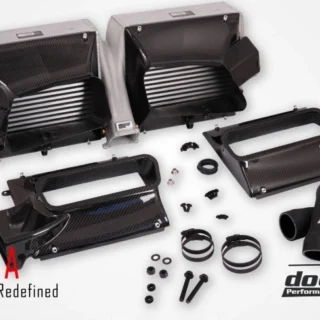
A true performance upgrade for the Porsche 911 (992) Turbo / Turbo S!
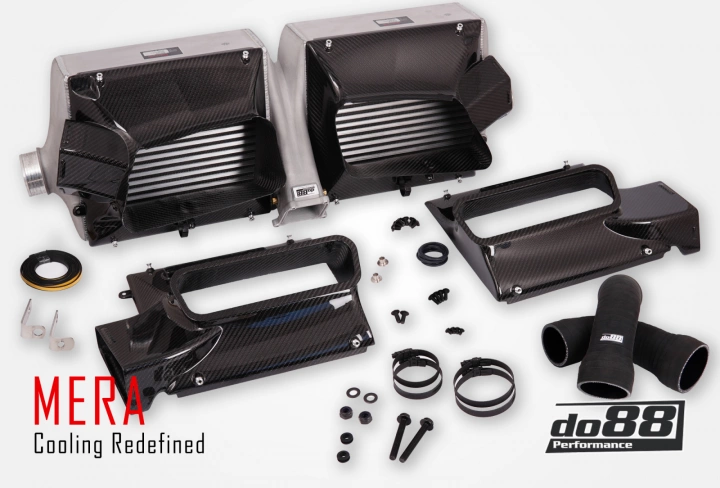
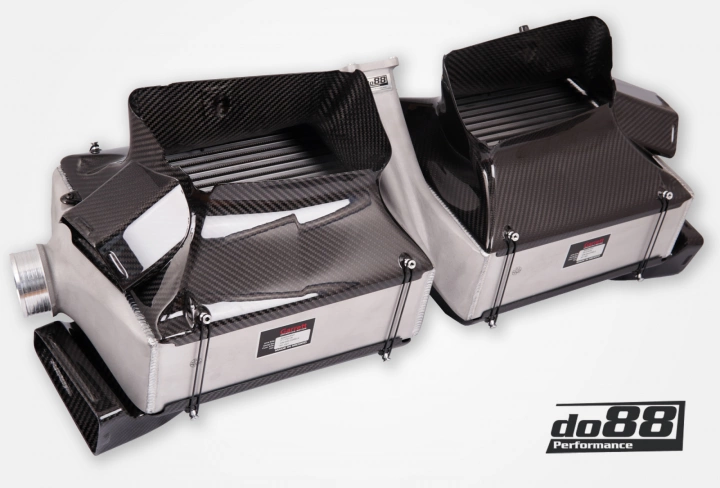
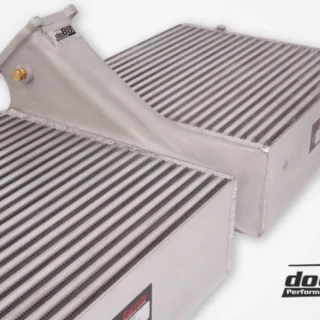
If you ask us, this is the best you can get from an intercooler kit for this platform. No stone was left unturned in our pursuit of maximum performance in every area of the system. The starting point is the renowned Garrett Motorsport cores, which are incredibly well-crafted with thin, stacked fins, precisely matching our specifications for cooling and airflow. The end tanks are made of thin die-cast aluminum to keep weight down while still utilizing airflow. To accommodate the thicker core, we replaced the air guides with the highest-quality carbon ducts! And to eliminate bottlenecks throughout the system, the intercooler connections were enlarged and fitted with DO88 silicone hoses designed with smooth, sweeping bends. We made no sacrifices or compromises during this development—behold the results!
Key figures:
– Cooler intake air temperature under the same conditions: 36°C / 96.8°F (48°C / 118.4°F). 12°C / (21.6°F) lower. See diagram under the product images.
– More air to your engine, less backpressure, and better airflow! Airflow at 0.125 bar / 1.81 psi pressure drop: 799 CFM (740 CFM), 8% more! See diagram under the product images.
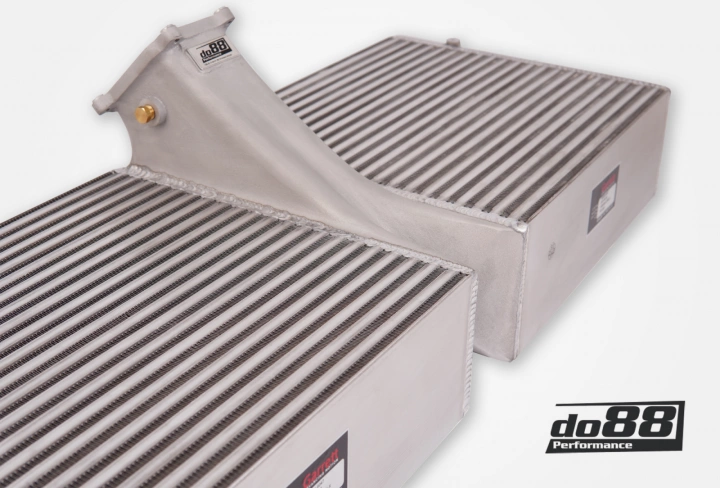
– Garrett’s high-density, sport-grade Bar & Plate cores.
– Freeform 3D cast reservoirs.
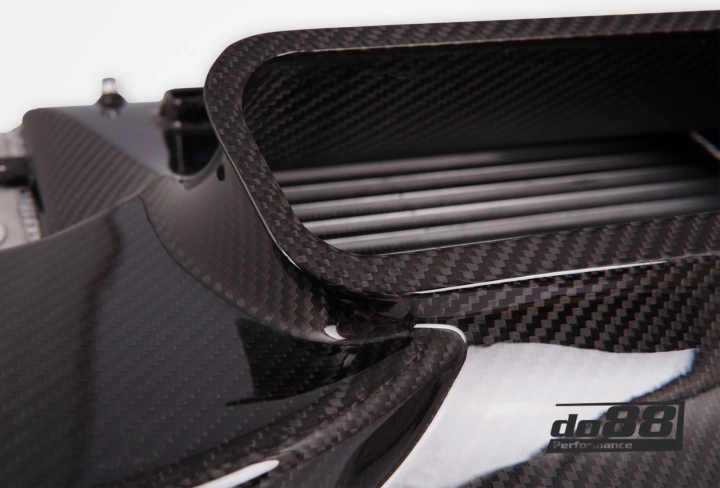
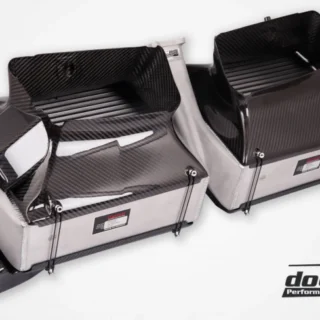
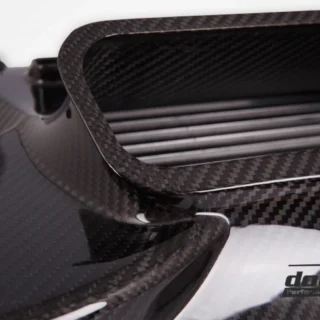
– Custom-designed carbon fiber ambient air guides.
– Comes with high-quality silicone hoses and installation hardware.
– Intercooler outlet reservoir meth caps (2 x 1/8 NPT).
Background:
Previous versions of the Porsche 911 had intercoolers inside each rear fender, with a Y-pipe joining them both before the charge air reached the intake manifold. The 992 has a completely different setup. The intercooler and Y-pipe are now combined in a single unit positioned under the rear wing. Ambient air is forced through channels from the rear window, into an intake on the decklid, and then through the intercooler core for optimal heat transfer. Looking at the construction from the side, this configuration actually makes more sense, but it’s also more challenging for us as manufacturers of high-performance cooling systems. To accommodate a core with greater volume and surface area, we had to develop new carbon ducts to allow for the increased thickness. We’re very happy to have taken our carbon production to the next level with this product: the fit and finish are worthy of an icon like the 911!
Garrett Cores:
The cores are Bar & Plate, made by the renowned Garrett Motorsport. Frankly, they’re as good as it gets. The thin, stacked cooling fins create a dense structure, providing very efficient heat transfer. The core measures 105 mm (4″), exactly the thickest possible for this application. Air is distributed throughout the core via free-form, cast-end reservoirs. Designing them was a significant undertaking, requiring multiple 3D scanning, CFD analysis, and 3D printing until a finished prototype was achieved. We chose, as usual, to use cast-end reservoirs because they allow for shapes that CNC machining can’t replicate, and for us, function always trumps form. Maximum airflow trumps bling! The reservoirs are made with 70 mm (2.75″) machined connections to allow for high yields. To match these larger connections, we also include silicone tubing. Both cores are joined by a central outlet reservoir to the inlet manifold, using machined connections and methanol plugs.
Carbon Ambient Air Guides:
The air guides are made of vacuum-infused prepreg carbon, and all pieces feature mounting grooves for the air channels, just like the OE tips. No matter how complex the shapes, we guarantee a perfect fit! They are fitted with appropriate rubber seals where necessary to prevent cooling air from escaping and passing through the core.
Performance:
When it comes to performance, the DO88 intercoolers significantly reduce intake temperature! The graph below shows the difference compared to the OE 992 units. Data was collected with an AIM race recorder during four consecutive runs in immediate sequence on a closed airstrip. Full-throttle accelerations between 50-250 km/h (30-155 mph) were performed on a Porsche 911 Turbo S (757 hp with updated software and exhaust). Hard braking, no cooling in between, only five times maximum. The rear wing was always in the upper position.
The test was conducted as follows:
First, four laps were run with the car equipped with the OE 992 intercoolers. Stop, quick swap of the DO88 intercooler components. Shakedown for a few minutes, and then five runs performed exactly as with the OE parts. The decrease in inlet air temperature is significant, with a peak delta of 12°C (21.6°F). See the diagram under the product images.
Cooling is important, as is airflow. After many hours of development, fine-tuning the final tanks, and choosing a core to meet our requirements, the result is a much more efficient intercooler in terms of heat transfer and airflow. Using our in-house flow bench, the Superflow SF-1020 Probench, airflow is verified for both the DO88 intercoolers and the OE 992 units. What you see is what you get: real performance!
First, four laps were run with the car equipped with the OE 992 intercoolers. Stop, quickly swap the DO88 intercooler components, a shakedown for a few minutes, and then five runs were performed exactly as with the OE parts. The decrease in inlet air temperature is significant, with a peak delta of 12°C (21.6°F). See the diagram below the product images.
Cooling is important, as is airflow. After many hours of development, perfecting the final tanks, and choosing a core to meet our requirements, the result is a much more efficient intercooler in terms of heat transfer and airflow. Using our in-house flow bench, Superflow SF-1020 Probench, airflow is verified for both do88 intercoolers and OE 992 units. What you see is what you get: real performance!